 Hotel Sentry
Leave it plugged in, arm it, and know the moment someone opens the door.
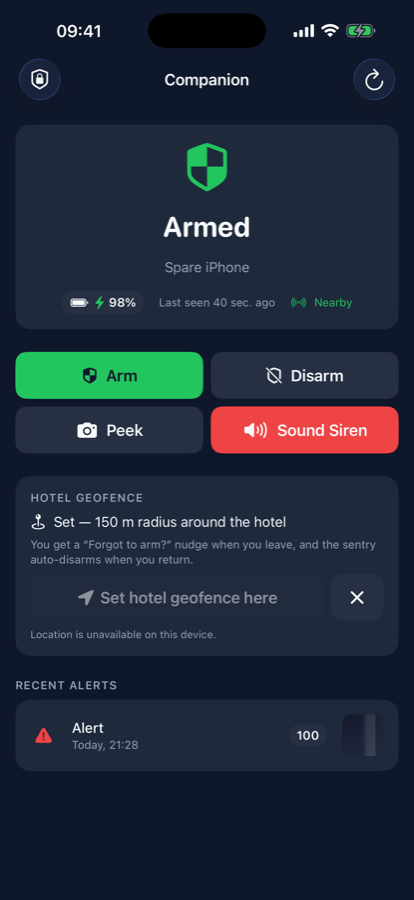

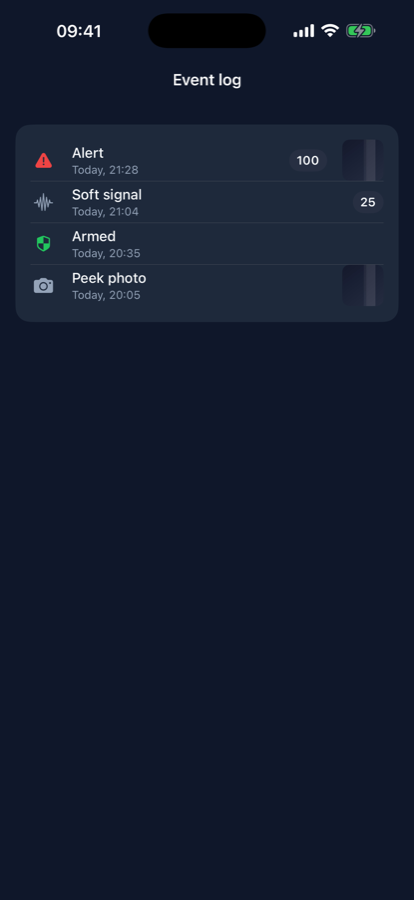
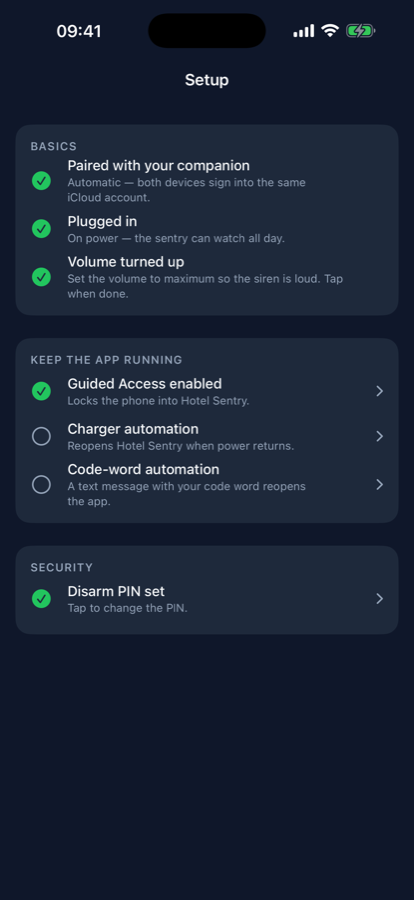
That drawer phone already carries a barometer, a microphone, an accelerometer and a camera. Together they make a better room sensor than most travel alarms you can buy — and reusing it costs nothing.
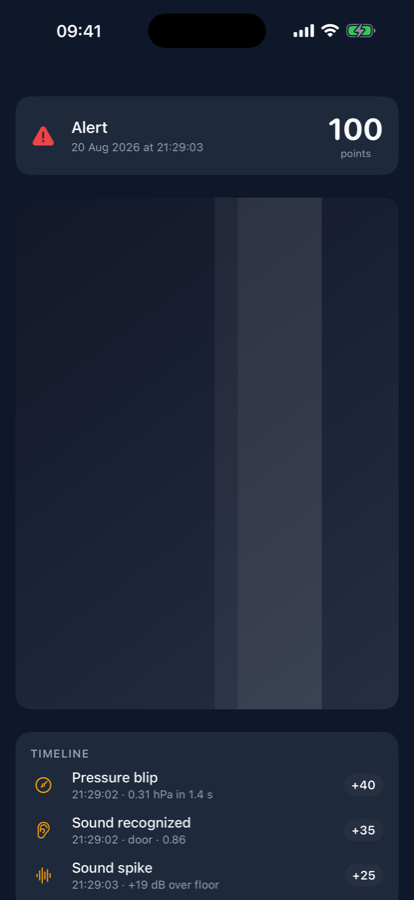
Hotel Sentry never fires on a single noise. It scores signals over a rolling ten-second window, and only alerts when they add up.
| Signal | What it means | Points |
|---|---|---|
| Pressure blip | The signature of a door opening in a closed room | 40 |
| Sound recognised | A door, a knock, or speech | 35 |
| Sound spike | Well above the room's own noise floor | 25 |
| Vibration | The phone or its surface is disturbed | 25 |
| Picked up | The phone is lifted — alerts instantly | 100 |
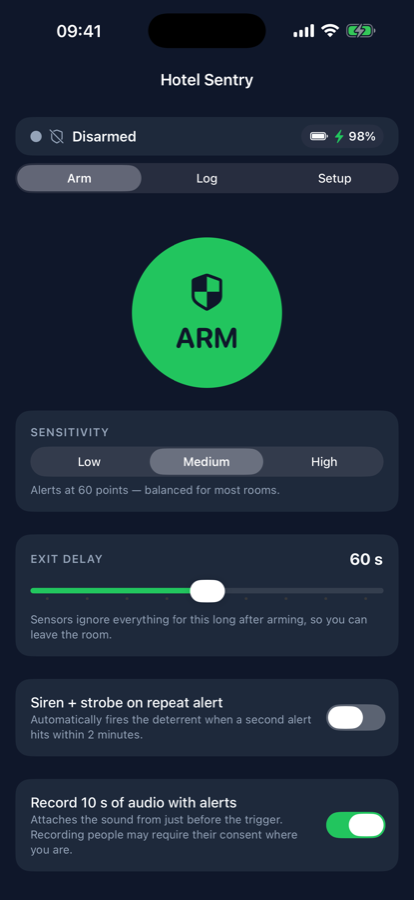
After arming, the app spends a minute learning the room — the air-conditioning rhythm, the background noise, the resting vibration. That calibration is why weather changes and a humming HVAC don't wake you at 3 a.m., but a door does.
Your two devices talk through your own private iCloud database. There is no Hotel Sentry server to breach, no account to create, and no analytics or advertising code in the app. Photos and clips are yours alone — the developer cannot see them, because there is nowhere for them to arrive.
Read the full privacy policy.
Hotel Sentry is an extra pair of eyes, not a replacement for a door lock, a hotel safe, or good judgement. Pressure detection needs a device with a barometer, and the room phone must stay plugged in with the app in the foreground.